
Who Gets Left Behind by Modern Healthcare?
A treatment can work and still never reach the people who need it.
EMS300 Student Conference 2026
10 min read
A screening programme can be free, a vaccine can be available and a treatment can be clinically effective. None of that guarantees that the people who could benefit will actually reach it.
Modern medicine is very good at asking whether something works. Clinical trials measure treatments, screening programmes look for disease earlier and public health interventions aim to reduce risk across whole populations. Yet once an intervention leaves the controlled world of research and enters everyday life, another question becomes just as important: who is actually able to benefit from it?
Across several projects presented at the EMS300 Student Conference, students have approached this problem from very different directions. Their research takes us from breast screening and childhood obesity to chronic pain, rural healthcare, vaccine hesitancy and the health of displaced populations. What connects these projects is a recognition that health is never determined by medicine alone. Income, geography, culture, trust, gender, previous experiences and the design of healthcare services can all influence whether care is accessible and effective.
Inequality, in other words, does not necessarily begin when healthcare is absent. It can exist even when the service, treatment or intervention is already there.
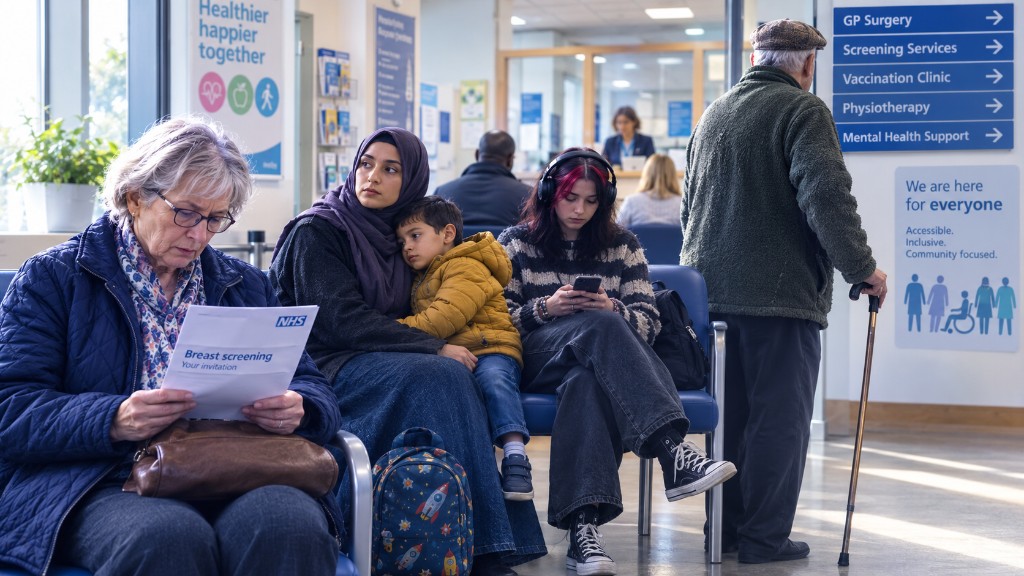
Breast screening provides a useful example. The basic public health logic is straightforward: mammography can identify some breast cancers before symptoms appear, offering the possibility of earlier diagnosis and treatment. A national screening programme therefore makes testing available to eligible women, but availability and uptake are not the same thing.
A student project examining barriers to mammogram screening in the UK identified four broad and interconnected areas: psychological and emotional factors, social and cultural influences, knowledge and awareness, and barriers within the healthcare system itself. Some of these can initially appear very personal. A woman may fear pain, feel embarrassed about the procedure or worry about what the test might find.
Yet those feelings do not develop in isolation. Anxiety may be affected by how well screening has been explained, cultural expectations, previous encounters with healthcare or difficulty communicating with services. Language barriers can make reliable information harder to obtain, while experiences of discrimination or poor care can influence whether reassurance from the healthcare system is trusted.
The result is a more complicated picture than simply dividing people into those who choose to attend and those who do not. Someone with limited information may feel more anxious about the procedure, while a previous negative experience can make future contact with healthcare less appealing. Rather than asking only why an individual did not attend, the research encourages us to consider what made attendance more difficult in the first place.
That change in perspective matters because it changes where responsibility for improving uptake might lie.
Few health problems expose the limitations of focusing entirely on individual behaviour as clearly as childhood obesity. Advice can sound deceptively simple: eat healthier food, exercise more and spend less time being sedentary. A student project titled Beyond Individual Responsibility: Exploring Childhood Obesity as a Multifactorial Public Health Challenge in the United Kingdom examined the much more complicated environment in which those choices are made.
The factors identified extended far beyond an individual child or family. Socioeconomic deprivation, food marketing, access to affordable healthy food, opportunities for physical activity, screen use and weight-related stigma all contributed to the wider picture. Discussions with healthcare professionals, educators, childcare practitioners and parents reinforced how difficult healthier behaviour can become when the surrounding environment continually works against it.
Advice to be more physically active, for example, means something different if there are few safe places nearby to exercise, organised activities are expensive or families have limited time and transport. Advice about diet is similarly affected by the cost and availability of healthier food and by constant exposure to marketing for foods high in fat, salt and sugar.
None of this means individual behaviour is irrelevant. It means that behaviour happens within social, economic and physical environments that shape which choices are realistically available. Education can help, and the project itself developed an educational resource for families, but information alone cannot remove all of the conditions influencing those decisions.
If the environment contributes to the problem, changing the environment also has to form part of the response.
Inequality can also emerge within the clinical encounter itself. A review titled Beyond Biological Sex: Gender, Chronic Pain, and the Future of Equitable Pain Management explored differences in how chronic pain is experienced and treated.
Women generally reported a greater burden of chronic pain, disability and healthcare use, but biological sex alone did not account for all of the differences identified. Social roles, coping strategies, support networks, medication effects and clinical perceptions of whether pain was legitimate could also shape people's experiences and treatment pathways.
This is particularly significant in pain medicine because pain cannot be measured in the same direct way as blood pressure or blood glucose. Assessment depends heavily on what the patient reports and on how that report is interpreted by the clinician. If gender influences how symptoms are expressed, how someone seeks help or how seriously their pain is perceived, then inequality can enter the system before a treatment decision is even made.
The issue is therefore not simply whether men and women experience pain differently. It is whether healthcare recognises that biology, social context and clinical interaction can all influence what happens after somebody says that they are in pain.
Research of this kind also complicates the idea that equitable healthcare simply means treating everybody identically. Sometimes fairness requires recognising that apparently similar clinical encounters do not begin from the same position.
Where somebody lives can shape healthcare just as powerfully as personal circumstances. A qualitative study of GPs providing chronic pain care in remote and rural Shetland explored what happens when specialist and community services are less readily available than they might be in a large urban centre.
The findings were not simply a story of rural healthcare being worse. GPs described continuity and long-term relationships with patients as genuine clinical strengths. Knowing someone over time could help clinicians understand their expectations, build trust and support them through a complex long-term condition.
At the same time, those relationships were sometimes compensating for limited access to specialist and community services. General practice could become the central hub for chronic pain care because responsibilities that might be distributed across several services elsewhere were concentrated in one place.
The project therefore challenges two assumptions. The first is that an urban model of healthcare can simply be reproduced at greater distance. The second is that rural care should automatically be understood only in terms of what it lacks. Shetland may have fewer services, but it may also provide forms of continuity that are difficult to achieve in larger systems.
Equity does not necessarily mean delivering healthcare in exactly the same way everywhere. Geography may require services to be organised differently if people are to have comparable opportunities for good care.
Public health becomes particularly complicated when access is not mainly about obtaining an intervention, but about whether people trust it enough to accept it.
Two projects in the conference collection examined vaccine hesitancy in very different settings. A systematic review of COVID-19 vaccine hesitancy in Ghana identified concerns about side effects, misinformation, conspiracy theories and doubts about vaccine effectiveness. Cultural and social influences also mattered, suggesting that approaches developed in one setting cannot necessarily be transferred unchanged to another.
A separate review examined polio vaccine hesitancy in Pakistan and Afghanistan, where vaccination takes place against a background of political instability, distrust and, in some areas, risks faced by vaccination workers. Here again, confidence in vaccination was shaped by a combination of misconceptions, religious and cultural beliefs and weaknesses within healthcare infrastructure.
It is tempting to treat vaccine hesitancy principally as a problem of insufficient information. Better information is certainly important, but these projects show that information is always received through relationships of trust. Who delivers a message matters, as do previous experiences of healthcare and government, community networks, political events and the credibility of the institutions providing vaccination.
This helps explain why simply repeating the same message more loudly may achieve very little. Trust cannot be distributed alongside a vaccine as an additional piece of patient information. It is part of the infrastructure on which successful public health depends.
There is another, less visible way in which people can be left behind: medicine may simply know less about them.
A project examining non-communicable diseases and mental health disorders among Palestinian refugees considered how geographical and residential fragmentation affects disease surveillance. Palestinian refugee populations live across camps, urban communities and different host countries, often within very different healthcare systems and living conditions.
The review found considerable variation between studies. Even residential context was not consistently reported, while different researchers used different sampling methods, diagnostic approaches and sources of health information. These inconsistencies made it difficult to determine how much variation in reported disease reflected genuine differences between populations and how much resulted from differences in the way health was being measured.
This exposes an important form of inequality because modern healthcare increasingly depends on data. Governments use it to allocate resources, researchers use it to identify patterns of disease and health services depend on it when planning care. Yet data do not simply appear because a population exists. They require systems capable of reaching people and sufficiently consistent methods to make comparisons meaningful.
Populations experiencing displacement, instability or fragmented healthcare may be precisely those for whom reliable information is most difficult to obtain. If some communities are harder to measure, they can also become easier to overlook.
Looking across these projects, one pattern becomes particularly clear: barriers rarely operate in isolation.
Someone may miss breast screening because of anxiety, but that anxiety may be connected to poor information, language difficulties or an earlier experience of healthcare. A family may understand exactly what constitutes a healthy diet while living in circumstances that make following that advice difficult. A person with chronic pain may encounter biological, social and clinical influences simultaneously, while distance from specialist services can fundamentally change what local clinicians are expected to provide.
The same is true of vaccination, where personal concerns can be intertwined with culture, political history and trust. Even the evidence used by healthcare systems can be affected by where people live and how easily their health can be recorded.
Healthcare often separates these problems because services need categories in order to respond to them: an education problem, a communication problem, a behavioural problem, a service problem. Real lives are less easily divided. The same person can experience several of these barriers at once, and one barrier can intensify another.
Understanding health inequality therefore requires more than identifying isolated obstacles. It means looking at how they accumulate.
Perhaps the most interesting feature of these projects is how often they shift attention away from asking what individuals are doing wrong and towards asking how systems could work differently.
A different starting point is to examine what makes access difficult. Information may be hard to understand, services may not fit people's circumstances, geography may limit what can realistically be provided and previous experiences may have damaged trust. Social and commercial environments can make healthier choices harder, while the evidence used to design services may not adequately represent the people who need them most.
Seen in this way, health inequality is not an unfortunate problem sitting at the edges of an otherwise successful healthcare system. It can be produced through the interaction between healthcare and the society in which it operates.
Medicine will continue to develop better treatments, technologies and ways of detecting disease. But progress cannot be judged only by what becomes technically or clinically possible. It also has to be judged by who is realistically able to benefit from those advances.
Sometimes the people being left behind are not outside the healthcare system at all. They are already within it, but using services that were never designed quite well enough around the realities of their lives.