
When Does New Technology Become Useful Medicine?
Impressive technology is easy to invent. Useful medicine is harder.
EMS300 Student Conference 2026
10 min read
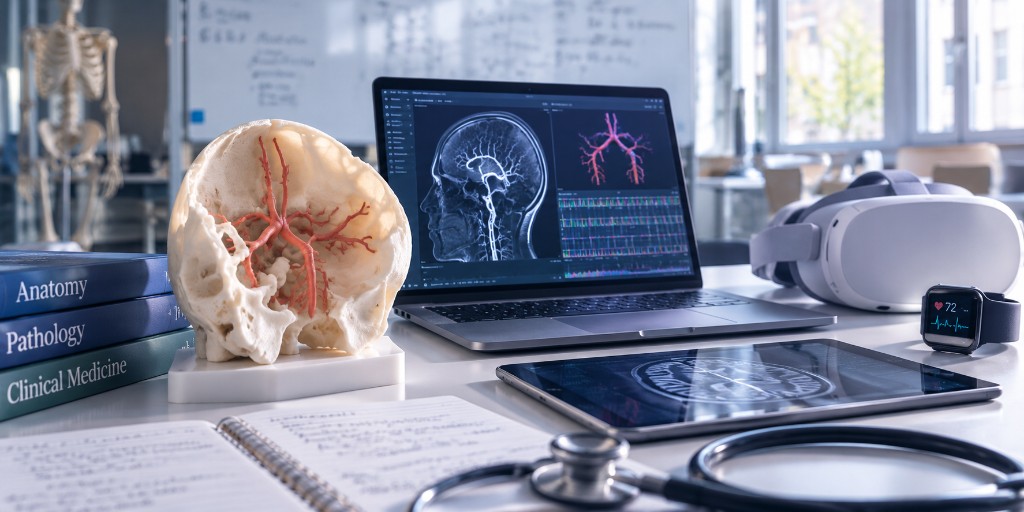
A virtual reality headset can recreate an operating theatre. A computer can search an entire bacterial genome for signs of antibiotic resistance. Artificial intelligence can find patterns hidden inside proteins, while a smartphone can analyse changes in someone's speech.
All of these technologies sound impressive, but medicine has never been short of impressive ideas. The harder question is what happens next. When does a technological possibility become something genuinely useful to a clinician, learner or patient? Does it improve a decision, make a difficult procedure safer, detect something we could not see before, or allow care to happen somewhere new? And, crucially, will people actually be able to use it?
Several projects presented at the EMS300 Student Conference approach these questions from very different directions. Together, they suggest that the future of healthcare may depend less on inventing technology for its own sake and more on finding the places where technology solves a problem medicine actually has.
Learning medicine has always involved an unavoidable tension. Students and trainees need experience, but the people on whom they are learning are real patients. This is particularly obvious in surgery, where technical skill, anatomical understanding and decision-making have to come together in situations where mistakes matter.
A student systematic review of virtual, augmented and mixed reality in neurosurgical training explored whether immersive technologies could provide another way to develop those skills. Across the studies reviewed, immersive simulation showed potential to improve technical performance, spatial understanding and confidence. In some studies, trainees completed tasks more quickly, with greater accuracy and fewer errors after training.
The attraction is not difficult to see. A virtual environment can be repeated, a difficult case can be practised again, and anatomy can potentially be explored from viewpoints that would be difficult to reproduce in a textbook. Mistakes can become learning opportunities without becoming clinical events. None of this means that a headset replaces the operating theatre. Rather, the value of simulation may be in allowing some learning to happen before clinical experience rather than instead of it, helping trainees arrive at the real situation better prepared.
That is a rather different ambition from simply making education more futuristic.
Not all digital medicine stays on a screen. Another project took a familiar but anatomically complex structure, the Circle of Willis, and asked whether it could be turned into an accurate, affordable 3D-printed teaching model.
Traditional anatomy education has enormous strengths, particularly through cadaveric learning, but there are practical limitations. Specimens are finite, anatomical structures can be difficult to visualise, and access is necessarily limited. A learner also cannot simply take a cadaveric specimen home to revisit a difficult piece of anatomy later.
A 3D-printed model changes some of those constraints. The student created models in different materials, had their anatomical accuracy assessed and gathered feedback from students and staff. Responses were positive, suggesting that the models could provide a useful supplement to existing approaches.
That idea of a supplement is important. Educational technologies are often described as though each new development will replace what came before it. Yet some of the most convincing uses of technology are much less dramatic. A printed anatomical model does not need to replace cadaveric dissection to be valuable. It can allow learners to hold a structure, rotate it, revisit it and explore spatial relationships repeatedly.
Sometimes innovation succeeds not because it transforms everything, but because it makes one part of learning noticeably easier.
The same principle applies to diagnosis. When a patient has a bacterial infection, laboratories can test which antibiotics the organism is susceptible or resistant to. These phenotypic tests are clinically valuable because they help guide treatment, but bacteria also carry another potentially useful source of information: their genomes.
A student project asked whether whole genome sequencing could help predict antimicrobial resistance in Enterococcus faecium, including strains resistant to vancomycin. The study compared predictions derived from genomic information with conventional laboratory antimicrobial susceptibility results and found a high level of agreement across the antibiotics examined.
Whole genome sequencing could also reveal relationships between isolates, identify resistance determinants and provide information that may be useful when investigating transmission or outbreaks. This illustrates an important distinction in digital medicine. Generating more data is relatively easy; generating data that changes a clinical decision is much harder.
A genome contains an extraordinary amount of information, but its medical value depends on being able to translate that information into something useful: which treatment might work, whether infections could be linked, or whether a new resistance mechanism may be emerging. The future laboratory may therefore not abandon conventional testing. Instead, genomic information could add another layer to it.
The innovation is not simply sequencing the organism. It is knowing what to do with the sequence once you have it.
Some of the technologies represented in the conference collection go a step further. Rather than simply processing familiar clinical measurements, they attempt to find meaning in biological information that is too complex for humans to interpret easily.
One project explored protein language models in lung adenocarcinoma survival prediction. The idea behind a protein language model is intriguing. Large language models learn statistical relationships within sequences of words, while related approaches can be trained on enormous numbers of protein sequences, learning representations of biological structure and function from patterns within them.
The student investigated whether these representations could make genetic mutations more useful when predicting survival in lung adenocarcinoma. The result is particularly interesting because it was not a story of artificial intelligence dramatically outperforming everything that came before it. Protein-language-model-derived information produced a modest improvement in one non-linear survival model compared with clinical information alone, yet the best-performing model overall remained one based on conventional clinical variables.
This is exactly the kind of result that makes research valuable. There is a tendency to discuss AI as though using a more sophisticated model automatically produces better medicine, but this project demonstrates why that assumption needs testing. A technically impressive method may add useful information in particular circumstances without replacing simpler approaches.
In healthcare, newer is not necessarily better, and more complicated is not necessarily more informative. Finding out when it is better is the research question.
There is an obvious trap in imagining healthcare technology from the perspective of the people developing it. A device may be technically sophisticated and scientifically valid, yet completely impractical for the people expected to use it.
A project examining digital monitoring in motor neurone disease starts from the opposite direction by asking patients what would actually work for them. Digital technologies could potentially allow people with MND to be monitored more continuously at home, reducing reliance on occasional snapshots obtained during clinical appointments. But MND also causes progressive changes in movement and function, meaning that an apparently simple digital task can become increasingly difficult.
The findings showed considerable openness towards digital monitoring, with familiar devices such as smartwatches and smartphones appearing particularly acceptable. Yet the concerns were revealing: difficulty of use and physical symptoms could both prevent engagement as the disease progressed.
This changes the technology question from "Can we build a system that measures this?" to "Can somebody living with this condition realistically use it?" A technologically elegant monitoring system that becomes unusable as a patient's condition progresses is not an elegant solution.
The study illustrates something that can easily get lost in discussions about digital transformation. Implementation is not something that happens after the technology has been developed. It is part of determining whether the technology works at all.
Technology is also beginning to change the physical tools used to treat patients. A student review and meta-analysis examined 3D-printed patient-specific implants for acetabular fractures, comparing them with conventional approaches.
Instead of relying solely on standardised implants, 3D printing creates the possibility of producing something designed around an individual patient's anatomy. Across the studies analysed, patient-specific approaches were associated with improvements in anatomical reduction as well as reductions in operating time and blood loss, although the evidence base also contained important limitations and variation between studies.
The larger idea is compelling. For much of medicine's history, treatment has required fitting individual patients into standard categories, doses, devices and procedures. Digital design and manufacturing make it increasingly possible to reverse that relationship and adapt the intervention to the individual.
That does not mean every patient will need something custom printed, but it illustrates how the boundary between digital information and physical treatment is beginning to disappear. A scan can become a digital model, a digital model can become an object, and that object can potentially become part of an operation.
Virtual operating environments, whole genome sequencing, protein language models, automated speech analysis, home monitoring and patient-specific implants represent very different kinds of innovation. Yet the projects share a surprisingly consistent message: the technology itself is rarely the end of the story.
A virtual simulation has to improve learning rather than simply look impressive. Genomic information has to help make sense of infection. An AI model has to add something beyond existing clinical information. Digital monitoring has to remain usable by the person being monitored. A personalised implant has to improve outcomes sufficiently to justify a different approach.
The question is therefore not whether medicine will become more technological. It already has. The more useful question is which technologies deserve to become part of medicine at all.
When people picture the future of healthcare, the images tend to be spectacular: intelligent machines, robotic surgery, immersive worlds and algorithms predicting disease before symptoms appear. Some of those things may indeed become commonplace.
But the student projects in the EMS300 collection suggest another version of the future, one that is perhaps less dramatic and more plausible. A trainee practises a difficult procedure several times before performing it on a patient. A microbiology team gets additional information about an outbreak from bacterial genomes. A person with MND uses a familiar device to share useful information without travelling to hospital. A clinician gains another clue about cognitive change from patterns in someone's speech. A surgeon uses an implant designed around the anatomy of the person on the operating table.
None of these eliminates the clinician, patient, laboratory or classroom. Instead, technology changes what each of them can do.
That may ultimately be the more meaningful definition of medical innovation: not technology that looks like the future, but technology that quietly becomes useful enough that, eventually, we stop thinking of it as technology at all.
We simply start calling it medicine.