
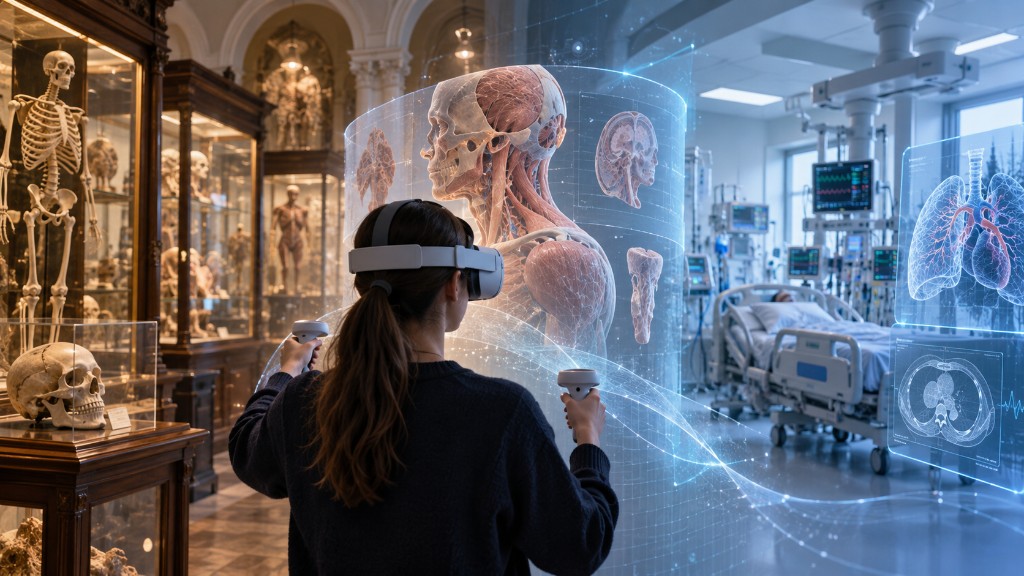
From Anatomy Museum to Critical Care: Exploring Medicine Through VR and Digital Models
What changes when a medical space is somewhere you can enter digitally?
EMS300 Student Conference 2026
9 min read
What changes when a medical space is no longer somewhere you can only visit, but somewhere you can enter digitally, explore at your own pace and return to whenever you need?
At the EMS300 Student Conference, the Digital Frontiers workshop gave students an opportunity to explore some of the immersive and interactive technologies being developed through the Medical School's 300th anniversary programme. Using virtual reality, digital environments and 3D models, the session moved between very different parts of medicine, from historical anatomy collections to the highly specialised environment of critical care.
The technology was certainly part of the attraction, but the workshop was intended to explore something more useful than novelty. The important questions were what these approaches might allow students to see, practise or experience that would otherwise be difficult, where immersion genuinely adds something to learning, and when a simpler digital model or browser-based experience might actually be the better choice.
That distinction has become central to the Digital Frontiers work. EMS300 created a space in which technologies could be tried with real audiences and in real settings, allowing the focus to move from asking what a technology can do towards asking what it is educationally useful for.
There is an obvious difference between looking at a photograph of a clinical environment and feeling as though you are standing inside it. Critical care is a particularly useful example because an intensive care setting contains a concentration of monitors, equipment, devices and clinical activity that can be unfamiliar and potentially overwhelming when encountered for the first time.
A digital recreation changes the way that environment can be explored. In virtual reality, the relationship with the space becomes physical and spatial: learners can look around, understand where equipment sits in relation to the patient, and begin to appreciate the layout and scale of the room. Instead of simply being told what is present, they can find and examine things for themselves.
That does not mean a virtual critical care environment can reproduce what it feels like to work in a real intensive care unit. It cannot fully recreate the pace, sound, emotional pressure, patient interaction or responsibility involved in clinical practice. Its value lies elsewhere, in providing a consistent and repeatable environment where learners can become more familiar with an unfamiliar space before some of those additional pressures are introduced.
Digital environments may therefore be particularly useful when they prepare learners for experiences rather than attempt to replace them. This fits a wider principle emerging from Digital Frontiers: virtual and interactive experiences can complement physical and clinical learning by allowing students to explore, repeat and build confidence before entering the real setting.
The anatomy museum presents a very different educational challenge. Museums contain objects that are valuable partly because they are unique, but that uniqueness also limits access. A specimen exists in one physical location, can only be viewed under particular conditions and may not always be easy to examine closely or from every angle.
Creating a high-quality 3D model changes that relationship with the object. A digital specimen can be rotated, enlarged and examined repeatedly, allowing learners to explore particular structures from perspectives that may be difficult when an object is behind glass. It can also be returned to after teaching or accessed in circumstances where a physical visit to the museum is not possible.
The point is not that the digital model is better than the original. A physical specimen has material qualities, scale, history and context that a digital reconstruction cannot reproduce. Instead, the two forms of access can support different kinds of engagement, with the physical museum providing an encounter with the real object and the digital version extending what learners can do with it.
This is one of the useful possibilities of digital resources: they can make otherwise difficult places and objects more accessible while giving learners greater control over how and when they explore them.
There is, however, an important difference between being able to view a digital object and having an educational experience built around it.
A beautifully scanned anatomical specimen may be technically impressive, but simply putting it on a screen does not automatically create learning. The educational value begins to increase when the learner is asked to do something with it: identify a structure, answer a question, compare two features, make a decision or receive feedback.
The same applies to virtual environments. Recreating a clinical room digitally is only the first step. Once the environment becomes a place where learners can encounter a scenario, make choices, receive information and try again, it begins to move from being a digital replica towards becoming an educational space.
The workshop provided an opportunity to demonstrate this distinction. Digital models and VR environments can support exploration, but their greater potential lies in combining that exploration with purposeful interaction. Questions, feedback, progression and opportunities to revisit material can turn an interesting digital object into something that supports learning.
One of the less dramatic advantages of digital learning is repeatability. A student can return to the same model, environment or activity several times and encounter a consistent version of it each time.
That can be particularly useful when learners are becoming familiar with complex anatomy or an unfamiliar clinical setting. They can move through an experience at their own pace, revisit something they did not understand and build confidence without needing to wait for another scheduled teaching session or clinical opportunity.
Repeatability also creates the possibility of changing the difficulty of the experience. A learner might initially explore a model with considerable guidance and then return later with fewer prompts. A clinical environment might first be used simply for orientation before later becoming the setting for a more complicated case or decision-making activity.
This makes digital resources potentially useful not because they make learning quicker, but because they can allow practice, reflection and another attempt to become part of the design.
Virtual reality naturally attracts attention because it is immersive, but one of the lessons from Digital Frontiers is that the most immersive technology is not automatically the most useful.
A VR headset can create a powerful sense of presence, but it also introduces practical requirements. Headsets need to be available, charged, maintained and cleaned. Users may need assistance, sufficient physical space is required, and some people may find wearing a headset uncomfortable or inaccessible.
A browser-based 3D model offers less immersion but considerably greater reach. It can potentially be accessed from a laptop or tablet without specialist equipment and revisited wherever the learner happens to be. Depending on the educational goal, that convenience may matter more than the extra sense of presence provided by VR.
The useful question is therefore not "Which technology is most advanced?" but "Which approach best supports what we want the learner to do?" Purpose, audience, accessibility, available resources and context all need to influence that choice.
The wider Digital Frontiers programme has involved taking immersive and interactive experiences beyond a single setting. Technologies have been used with school pupils, members of the public, students, alumni and community groups, and those contrasting settings have revealed different strengths and limitations.
An activity that works well with a small group receiving individual support can behave very differently when large numbers of people are moving through an event. Someone using VR for the first time may need more explanation than an experienced user, while confidence with digital technology, prior knowledge, physical environment and the purpose of the activity all shape how people engage.
These experiences reinforce a simple but important point: there is no single generic user. A successful digital activity has to make sense for the people using it in the environment where it is actually taking place.
For educational use, that means accessibility cannot simply be added at the end as a technical requirement. Some learners may benefit from being able to control the pace of an experience, reduce sensory demands or access the same content through an alternative route. Clear structure, predictable interaction and immediate feedback can be helpful for many learners, including those with different levels of digital confidence or different learning needs.
This may be the most important shift represented by the workshop.
There is an initial stage in digital innovation where the question is naturally "Can we make this?" Can a physical environment be recreated? Can an object be scanned? Can somebody enter it in VR? Can the model run in a browser?
Once those questions have been answered, however, the more important educational questions begin. What should the learner do when they enter the environment? What should they notice? What decisions should they make? What feedback should they receive, and how will the experience connect with the rest of their teaching?
The next stage is therefore not simply to make more digital models or build more virtual spaces. It is to develop structured learning around them, using interaction, questions, cases, feedback and repeated practice where those approaches genuinely add value. Digital experiences work best when they sit within a wider educational ecosystem of teaching, discussion and reflection rather than being treated as self-contained technological attractions.
At first glance, a workshop involving VR headsets, 3D anatomy and a virtual critical care environment could easily be described as a demonstration of new technology. That would only capture part of what was happening.
The more interesting possibility is that these technologies allow familiar educational problems to be approached differently. An inaccessible object can become explorable. An unfamiliar clinical environment can be encountered before a placement. A learner can repeat an experience rather than relying on a single opportunity, and an existing digital model can become the basis for questions, scenarios and feedback rather than remaining something that is simply viewed.
The practical challenges are equally important. Digital innovation requires equipment, development time, testing, support and maintenance, and a prototype that works successfully with a small supported group is not automatically ready for use across an entire curriculum. Sustainable educational technology has to work not only technically, but practically and inclusively in the environment in which it will actually be used.
That is why the most useful outcome of exploring VR and digital models may not be the technology itself. It is a clearer understanding of when these approaches genuinely add something to learning, what they require to succeed and where another approach might be better.
Three hundred years after the Medical School was founded, anatomy, clinical environments and the experience of learning medicine remain central. What is changing is the range of spaces in which that learning can now take place.
A museum specimen can leave its display case without the original object moving. A critical care environment can be entered before a student arrives on the ward. A physical model can become an interactive learning activity, and an experience that once depended on being in one place at one time can potentially be revisited whenever it is needed.
The interesting frontier is therefore not simply virtual reality or 3D technology. It is what happens when these tools stop being demonstrations of what is technically possible and start becoming thoughtful parts of how medicine is taught.